 There was a time when cybersecurity in manufacturing mostly meant keeping the accounting computers clean and making sure nobody clicked something stupid in an email.
Those days are gone.
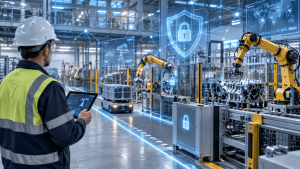
Today, the cybersecurity risks manufacturers face can reach from the front office all the way to the plant floor. Your ERP talks to production systems. Engineers remotely connect to equipment. Barcode scanners depend on wireless networks. Vendors need access. PLCs, HMIs, workstations, servers, cloud applications, and employee devices are all connected in ways they weren’t 15 years ago.
That’s great when everything works.
When it doesn’t, you can have a much bigger problem than a frozen laptop.
A cyber incident can interrupt production, compromise intellectual property, create compliance issues, and put your team in the uncomfortable position of figuring out which systems can still be trusted. NIST has specifically addressed cybersecurity in industrial control system environments because modern manufacturers increasingly depend on interconnected IT and operational technology systems.
So let’s skip the scare tactics and talk about the problems you can actually do something about.
Here are seven cybersecurity risks manufacturers can’t afford to ignore.
1. Unpatched Legacy Systems
Every manufacturer has that machine.
You know the one.
It still runs. It makes good parts. Nobody wants to touch the computer next to it because the software was written when flip phones were considered advanced technology.
Legacy systems aren’t automatically insecure. But unsupported operating systems, aging industrial software, and equipment that can’t accept normal security patches can create serious gaps.
The problem gets worse when nobody knows those gaps exist.
A good cybersecurity program starts with an inventory. What do you have? What operating system is it running? Is it supported? Can it be patched? What can it communicate with?
Sometimes you can’t update a legacy production system without risking compatibility problems. That’s reality.
The answer isn’t necessarily to rip it out.
Instead, you may need compensating controls such as network segmentation, restricted access, application allowlisting, stronger monitoring, and isolation from systems that don’t need to communicate with it.
You don’t protect an old press computer the same way you protect a new office laptop.
2. Poor Separation Between IT and OT Networks
Here’s where manufacturing cybersecurity gets different from regular office IT.
Your business systems and production systems increasingly need to communicate. That’s useful. It can also create a path an attacker can use to move through your environment.
If the receptionist’s computer, engineering workstation, ERP server, and production equipment all live on one big happy network, you may be giving a problem more room to travel than it needs.
Network segmentation helps create boundaries.
Your production equipment should not automatically have the same access as every device in the office. Critical systems can be separated into controlled network segments with rules governing what traffic is allowed between them.
NIST’s manufacturing guidance specifically addresses the challenge created as organizations connect OT and IT environments to gain productivity and connectivity.
Segmentation isn’t about making the network complicated for the fun of it.
It’s about putting fire doors in the building.
If something catches fire in one room, you don’t want the flames racing through the entire plant.
3. Weak Remote Access
Remote access has become part of manufacturing.
Machine vendors use it.
ERP providers use it.
Controls engineers use it.
Internal IT uses it.
Sometimes the owner uses it from home because apparently owning a manufacturing company means you’re never really off the clock.
Remote access can be incredibly useful. Poorly controlled remote access can also create another entry point into critical systems.
Manufacturers should know:
Who can remotely access the network?
What systems can they reach?
Are individual accounts being used?
Is multifactor authentication enabled?
Are access sessions logged?
Does access expire when it’s no longer needed?
Can a vendor connect directly to production equipment without going through a controlled process?
That last one matters.
The goal isn’t to prevent your controls contractor from doing their job. The goal is to know who has the keys to the building.
4. Shared Accounts and Excessive Permissions
Everybody has seen this one.
A computer on the floor has a shared username and password taped to the monitor.
It’s convenient.
It’s also difficult to secure and nearly impossible to audit properly.
If six people use the same account and somebody changes a configuration, downloads malware, deletes a file, or accesses something they shouldn’t, how do you know who did it?
You may not.
Permissions can cause similar trouble.
An operator probably doesn’t need administrator rights. A temporary employee doesn’t need access to every shared folder. A former vendor shouldn’t still have credentials six months after the project ended.
Good access control means giving people the access they need to do their jobs—and no more.
5. Inadequate Backup and Recovery Planning
Plenty of companies have backups.
Far fewer know whether those backups will actually save them when everything goes sideways.
That’s an important distinction.
If ransomware hits your ERP server Friday morning, saying, “Don’t worry, we have backups,” isn’t enough.
You need to know:
How recently was the ERP backed up?
Is the backup isolated from the production network?
Can ransomware reach the backup too?
How long will restoration take?
Who is responsible for recovery?
What’s the recovery order?
What happens to production while systems are restored?
A backup is a copy.
A disaster recovery plan is how you’re going to use that copy to get the plant moving again.
Those aren’t the same thing.
Manufacturers should regularly test recovery processes instead of discovering during an emergency that the backup job has quietly been failing since February.
6. Employees Who Haven’t Been Trained for Today’s Threats
Most employees aren’t trying to create security problems.
They’re trying to get their jobs done.
That matters because attackers understand it.
A convincing phishing email can look like a purchase order, Microsoft password notice, shipping notification, benefits document, or message from an executive.
And your plant isn’t full of cybersecurity analysts.
Nor should it be.
Employees need straightforward training that helps them recognize suspicious activity and gives them an easy way to report it.
Don’t turn cybersecurity awareness into a four-hour annual slideshow everybody clicks through while eating lunch.
Make it practical.
Show people what a suspicious login request looks like. Explain why MFA matters. Teach employees how to report an unexpected attachment. Run reasonable phishing simulations and use mistakes as training opportunities.
Your people can become one of your strongest security layers.
But only if somebody shows them what to watch for.
7. No Clear Cybersecurity Ownership
This may be the biggest one.
When something goes wrong, who owns it?
Internal IT says it’s the ERP vendor.
The ERP vendor says it’s networking.
The network provider says the machine vendor changed something.
The machine vendor says their equipment is working fine.
Meanwhile, production is still down.
Sound familiar?
One of the most expensive cybersecurity risks manufacturers face isn’t a specific technology problem. It’s fragmented responsibility.
Modern manufacturing environments involve a lot of vendors, and no IT provider is going to be an expert on every PLC, ERP package, machine controller, cloud platform, or industry-specific application.
But somebody still needs to quarterback the problem.
A strong technology partner should help coordinate vendors, document the environment, manage security responsibilities, and stay on the issue until the right people are working together.
If you’re looking at your current setup and realizing too many things fall between the cracks, take a look at Iler Networking & Computing’s IT services.
What Manufacturing Cybersecurity Should Look Like
Cybersecurity doesn’t have to mean building Fort Knox around every computer in the building.
It means knowing what matters most.
Protect critical systems.
Separate systems that don’t need unrestricted access to each other.
Control remote connections.
Use MFA.
Patch what can safely be patched.
Protect what can’t.
Monitor for suspicious behavior.
Maintain reliable backups.
Test recovery.
Train employees.
And have a plan before you’re standing in the middle of the plant at 5:15 in the morning wondering why nobody can log into the ERP.
For manufacturers looking for a structured framework, NIST’s guidance is a solid place to start. Its Cybersecurity Framework provides a risk-based approach organizations can use to understand, prioritize, and communicate cybersecurity efforts.
For manufacturing-specific guidance, see NIST’s industrial control system cybersecurity resource.
The hard part about cybersecurity is that good security can be invisible.
When everything works, nobody walks into your office and says, “Great job preventing that ransomware incident today.”
They see the machines running.
Orders shipping.
Scanners working.
ERP responding.
That’s exactly the point.
The best way to deal with the cybersecurity risks manufacturers face is before they become production problems.
You’ve already built something worth protecting. The next step is finding out where the weak links are before somebody else does.
Request a Manufacturing IT Assessment and get a clearer picture of where your manufacturing IT environment is strong, where you’re exposed, and what should be addressed next.