 Business continuity for small businesses isn’t just about storing files—it’s about preserving your operations, your reputation, and your livelihood. In today’s fast-moving world, power outages, natural disasters, hardware failures, and ransomware attacks can happen without warning. And while most business owners believe they’re protected because they back up their data, the reality is more complex—and more dangerous.
Restoring a backup isn’t the same as keeping your business operational. If your systems are offline, your team can’t work, your clients can’t get help, and your reputation starts to take a hit within hours. For small businesses, even a single day of downtime can lead to lost revenue, missed opportunities, and long-term damage.
Why Backups Are Not Enough
Backups are just the starting point. A backup can restore files, but it can’t restore productivity, access, or client confidence. What you need is a complete business continuity strategy—a proactive, tested plan that ensures your business keeps running even in the worst-case scenario.
A business continuity plan goes beyond simple data recovery. It outlines:
-
How quickly your team can regain access to critical systems
-
Where employees can work if your physical office is unavailable
-
What tools and platforms will keep communication flowing
-
Who is responsible for executing the recovery process
-
Whether your response meets compliance standards
And critically, it ensures that your systems and data can be accessed securely from anywhere, with minimal interruption.
Backup vs. Continuity: Understanding the Difference
Think of it like this:
-
Backups help you recover data.
-
Business continuity helps you recover operations.
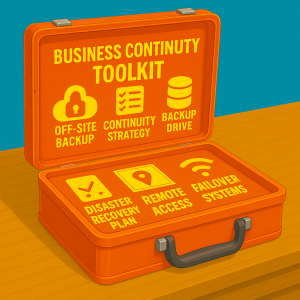
Your business continuity plan should include:
-
Encrypted, off-site, and immutable backups that can’t be altered or deleted by attackers
-
Failover systems and redundancies for critical services like email, file access, and phones
-
Recovery time objectives (RTO) and recovery point objectives (RPO) tailored to your operations
-
Remote access capabilities to support work-from-anywhere scenarios
-
Regular testing and simulation to make sure your plan actually works
Without these elements, you’re not truly prepared—you’re just hopeful.
Real Disasters. Real Consequences.
This isn’t just theory. In the past few years alone, we’ve seen disasters hit small businesses across the country—and the fallout has been brutal:
-
Florida hurricanes left small offices underwater. Businesses without remote access or cloud backups were offline for weeks.
-
North Carolina floods took out entire server rooms, leaving companies scrambling to rebuild lost records and systems.
-
Wildfires in California destroyed offices and local infrastructure—many businesses with no off-site solutions never reopened.
-
Ransomware attacks hit a CPA firm with local-only backups. The criminals encrypted everything—including the backups. They had no way to recover.
These aren’t big corporations. These are businesses like yours—ones that didn’t think disaster would happen to them.
5 Questions Every Business Owner Should Ask Their IT Provider
If your systems went down right now, would your business survive the next 48 hours?
Ask your IT provider:
-
How quickly can we recover if we’re hit with ransomware?
-
Are our backups tested and isolated from cyber threats?
-
What happens if our physical office is destroyed or inaccessible?
-
Can our team work remotely with full access to systems and data?
-
Does our plan align with HIPAA, PCI, or other compliance standards?
If your provider can’t answer confidently—or if they’ve never had this conversation with you—you’re overdue for a serious discussion.
Why Business Continuity Matters Now More Than Ever
The risks are growing. Weather patterns are more extreme. Cyberattacks are increasing in sophistication and frequency. And hybrid work has made continuity even more critical.
Small businesses are often the hardest hit because they lack the in-house resources to respond quickly and effectively. But that doesn’t mean you’re helpless—it just means you need the right partner.
At ILER Networking & Computing, we specialize in business continuity for small businesses. Our approach goes beyond basic IT support. We help you build a resilient, adaptable operation that can handle whatever comes next.
What a Great IT Provider Should Do
A good IT provider helps you recover after a disaster.
A great one ensures you never go offline in the first place.
We don’t just back up your files. We design and test continuity strategies that:
-
Keep your business operational
-
Support secure remote work
-
Protect against ransomware
-
Ensure regulatory compliance
-
Give you peace of mind
Take the First Step Toward Resilience
You don’t need to figure this out alone. Whether you’re in a regulated industry like healthcare, finance, or legal—or just want to protect your bottom line—we’ll help you build a business continuity strategy that works.
Schedule your FREE Network Assessment today and find out exactly where your vulnerabilities lie—and how to fix them before it’s too late.
Bonus Resource:
For an additional deep dive into what business continuity really looks like, check out the Ready.gov guide on Business Continuity Planning. It’s a solid government resource every business should review.