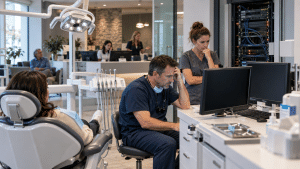
 Here is a question every dental practice owner should be able to answer:
If your server stopped working tomorrow morning, what would happen next?
Not eventually.
Not after somebody calls three vendors and figures out who installed it.
Tomorrow.
At 8:00 a.m.
With patients already arriving.
Could your front desk access the schedule?
Could your assistants open patient information?
Could your clinical team retrieve X-rays?
Could your hygienists review histories and notes?
Could you check patients out?
Most importantly, would your team know what to do?
For many practices, dental server downtime is one of those risks nobody thinks about until the server actually stops working.
And by then, every minute suddenly matters.
Your Server May Be Doing More Than You Realize
When everything works properly, your server is easy to ignore.
It sits quietly in a closet, equipment room, or server rack doing its job.
But depending on your technology setup, that server may support or store information connected to:
-
Practice management software
-
Patient records
-
Scheduling
-
Treatment plans
-
Billing
-
Imaging databases
-
Shared documents
-
Scanned records
-
Accounting applications
-
Network services
-
Other dental software
That means dental server downtime is rarely just one broken computer.
It can affect multiple departments simultaneously.
Your receptionist cannot see the schedule.
The assistant cannot find the image.
The office manager cannot get into a shared folder.
The hygienist is waiting.
The patient is waiting.
And suddenly half the team is standing around asking the same question:
“Who do we call?”
What Does Dental Server Downtime Actually Cost?
The easiest cost to calculate is lost production.
Imagine a practice that normally produces $8,000, $10,000, or more during a full clinical day.
If a server outage forces procedures to be delayed or rescheduled, the financial impact can add up quickly.
But production is only part of the story.
There is also staff productivity.
Even when employees remain on the clock, they may accomplish significantly less when critical systems are unavailable.
Then there is schedule disruption.
Patients need phone calls.
Appointments need to be moved.
Treatment gets pushed into already busy future days.
Your front desk may spend hours repairing a schedule that technology disrupted in minutes.
And then there is the patient experience.
Patients generally do not care whether the server crashed because of a failed drive, outdated hardware, corrupted software, a network issue, or something else.
They know their appointment was delayed or cancelled.
That is the hidden cost of dental server downtime: one technical failure creates operational consequences throughout the practice.
“We Have a Backup” Does Not Answer the Question
Whenever server failure comes up, someone usually says:
“We have backups.”
Excellent.
You should.
But a backup and a recovery plan are not the same thing.
The important question is:
How quickly could you use that backup to get the practice operational again?
HHS guidance concerning ransomware recovery emphasizes frequent backups as well as periodically performing test restorations to verify that data can actually be recovered.
That principle matters for everyday server failures too.
You want to know that your backup is not only present, but usable.
A real recovery strategy should answer:
-
How frequently is important data backed up?
-
Is there an offsite or otherwise appropriately protected copy?
-
Who receives alerts if a backup fails?
-
When was a restoration last tested?
-
How much data might be lost between the last backup and the failure?
-
How long should recovery reasonably take?
-
What hardware or services would be needed if the server completely failed?
Those answers help transform dental server downtime from an unpredictable catastrophe into a manageable business interruption.
Recovery Time Matters to Dental Practices
Imagine two practices experience identical server hardware failures.
Practice A has backups.
Practice B has backups too.
But Practice A has documented recovery procedures, known recovery priorities, recent backup testing, current server documentation, and an IT provider familiar with its dental applications.
Practice B has a backup drive somewhere.
Those are two very different situations.
The question is not merely whether the data survives.
The question is how efficiently the practice can return to patient care.
In dentistry, speed matters because the schedule is the engine of the business.
Every operatory represents production.
Every delayed appointment affects patient flow.
Every technology problem pulls somebody away from their real job.
Your IT strategy should therefore be built around business continuity, not just equipment maintenance.
Do You Know How Old Your Server Is?
Server age is another uncomfortable question many practice owners cannot answer.
Maybe it was installed three years ago.
Maybe six.
Maybe the previous dentist bought it.
Maybe nobody is entirely sure.
The server still works, so replacing it never feels urgent.
That logic works beautifully right up until the morning it does not boot.
Technology has a lifecycle.
Hardware wears out.
Operating systems eventually reach end of support.
Storage fills.
Practice applications evolve.
Security requirements change.
And an older server can gradually become a bigger operational risk.
A proactive dental IT plan should therefore include a hardware roadmap.
That means documenting what equipment exists, understanding its condition and support status, and planning upgrades before emergency replacement becomes the only option.
Planned spending is much easier to manage than emergency spending.
What Happens When Your IT Provider Does Not Understand Dental Software?
Getting the server running is only part of recovery.
Your dental applications need to work too.
Your practice may rely on platforms such as Open Dental, Dentrix, Eaglesoft, Dexis, Carestream, or other specialized dental software and imaging systems.
Those systems may have specific database locations, services, network requirements, permissions, and integrations.
That is why dental experience matters.
After a server outage, you do not want your IT company saying:
“The network works. Call your dental software company.”
Then the software company says:
“The server is the problem. Call your IT company.”
Then your office manager spends two hours going back and forth between vendors while patients sit in the reception area.
Dental practices need an IT partner willing to coordinate with technology vendors.
No finger-pointing.
No passing the ticket around.
Just ownership.
Vendor management is one of the most valuable parts of outsourced dental IT because it lets your team return to dentistry instead of becoming unpaid technology project managers.
You can explore that approach through ILER’s dental IT services.
What Should Your Team Do During Dental Server Downtime?
Every practice should have a basic downtime procedure.
It does not need to be a 76-page emergency manual nobody reads.
It needs to answer practical questions.
Who contacts IT?
Who has authority to make operational decisions?
How does the practice access emergency contact information?
Can staff determine which patients are scheduled?
What information can safely be documented temporarily?
How are patients informed if appointments need to change?
How is temporary documentation entered into the appropriate system later?
Which procedures cannot safely continue without access to digital records or imaging?
Your clinical and compliance advisors should help determine the appropriate procedures for your specific practice.
The important thing is to establish them before the outage.
A plan created calmly on Wednesday afternoon will usually be much better than one invented during dental server downtime with twelve patients in the building.
Could You Run Temporarily Without the Server?
Your answer will depend on how your practice technology is configured.
Some cloud-based services may remain accessible during a local server failure.
Other critical applications may depend heavily on the server.
The right business continuity strategy begins by mapping those dependencies.
Ask your IT provider:
“What stops working if our server goes down?”
Then ask:
“What is our workaround for each critical system?”
This conversation can reveal uncomfortable surprises.
Maybe your phones depend on the internet.
Maybe your imaging software depends entirely on one server.
Maybe no one knows the administrator password for an important application.
Maybe your backup has never been restored.
Better to discover those things today.
Prevention Is Cheaper Than Panic
Not every server failure can be prevented.
Hardware fails.
Software misbehaves.
Power problems happen.
Cybersecurity incidents happen.
People make mistakes.
The goal is not to promise that technology will never break.
That would be unrealistic.
The goal is to reduce preventable failures, detect problems early, and recover quickly when something does happen.
That can involve proactive monitoring, software updates, hardware lifecycle management, network maintenance, backup verification, documented recovery planning, and ongoing support.
For a dental practice, the benefit is not “better IT” in the abstract.
The benefit is keeping operatories productive.
Keeping patients moving.
Keeping the front desk functioning.
Keeping doctors out of technology emergencies.
That is the return on investment.
Your IT Plan Should Protect the Schedule
Dental practice owners carry enough responsibility already.
You are responsible for patients, employees, payroll, production, compliance, equipment, leadership, and the hundred little emergencies nobody else sees.
You should not also spend your evening wondering whether the server will start tomorrow.
A healthy technology environment gives you something much more valuable than faster computers.
It gives you confidence.
You know the systems are being monitored.
You know the backups are being checked.
You know aging equipment is being planned for.
You know somebody understands your dental applications.
And if something fails, you know exactly who owns the problem.
That is what good dental IT should feel like.
Quiet.
Reliable.
Almost boring.
Because when your practice technology becomes exciting, it is usually for the wrong reason.
Find Out How Prepared You Are Before the Server Goes Down
Do not wait for dental server downtime to discover how long recovery would take.
Ask your IT provider to walk you through the process today.
What fails?
What keeps working?
Where is your data?
How recent is the backup?
Has recovery been tested?
Who contacts your dental software vendors?
How quickly could the practice reasonably return to normal operations?
If those questions do not have clear answers, that is an opportunity to strengthen your technology strategy before an outage forces you to.
Start with a Free Dental IT Review at iler-dental-it.com.
Because the best time to prepare for dental server downtime is while your server is still quietly doing its job.